
A Bristol company claims to have developed the world’s first carbon negative technology for the production of plasterboards.
According to the company behind the innovation, Adaptavate, this leap from producing low-carbon construction materials to providing an additional carbon-negative product comes through the incorporation of char.
This is produced by the pyrolysis of ligno-cellulosic materials – basically wood – which locks the CO2 sequestered by plants into a stable state, and subsequently into the board, preventing it from being released through decay.
Tom Robinson, founder and chief executive of Adaptavate, said: “Our new carbon-negative and carbon-storing technology marks a significant milestone and step forward not only for Adaptavate, a business I founded a decade ago, but also for the global construction industry as a whole.
“Plasterboard is one of the most heavily used construction materials after cement and steel, in an industry that produces around 40% of the world’s carbon emissions.
“As a former builder, the potential impact of putting carbon storing building materials in the hands of every builder, architect and developer around the world as a drop-in solution is massive in our global endeavour to decarbonise construction.”

Adaptavate’s innovative technology allows for CO2 savings through both its product formulation and manufacturing methods, the company claims. It repurposes ligno-cellulosic wastes, combining them with minerals and a small amount of water to create a flat board material.
Unlike conventional board production, this process requires no natural gas and can absorb low concentration CO2 in the curing process, which can be sourced from industrial emissions during the curing stage.
The development of this new technology and the pilot line for the board’s production was made possible by UK government grants, through Innovate UK, and investment from a group of climate-focused businesses dedicated to accelerating carbon removal within the construction industry. The latter include Counteract, Perivoli Innovations, Low Carbon Innovation Fund 2 (LCIF2), and SEMIN Group.
Jeff Ive, chief technology officer at Adaptavate, said: “The production of full-sized permanently carbon-storing plasterboard is a major step forward for Adaptavate, and the scale up of our regenerative material solutions.
“We have brought together a systemic solution for carbon dioxide removal that is required on a global scale, and matched it with a product that is used on a similar scale. With our licencing business model, we aim to deliver these systemic innovations at a rate that the planet needs them.
“The innovations’ development is thanks to the expert international team we have at our Bristol headquarters. With their knowledge, skills and dedication we have produced a game changing carbon-storing product with a comparable performance to the incumbent.
“The past few years of innovation in this space have been exciting for us, and we can see that this core technology has some important attributes that could be well used in a diverse product portfolio.”
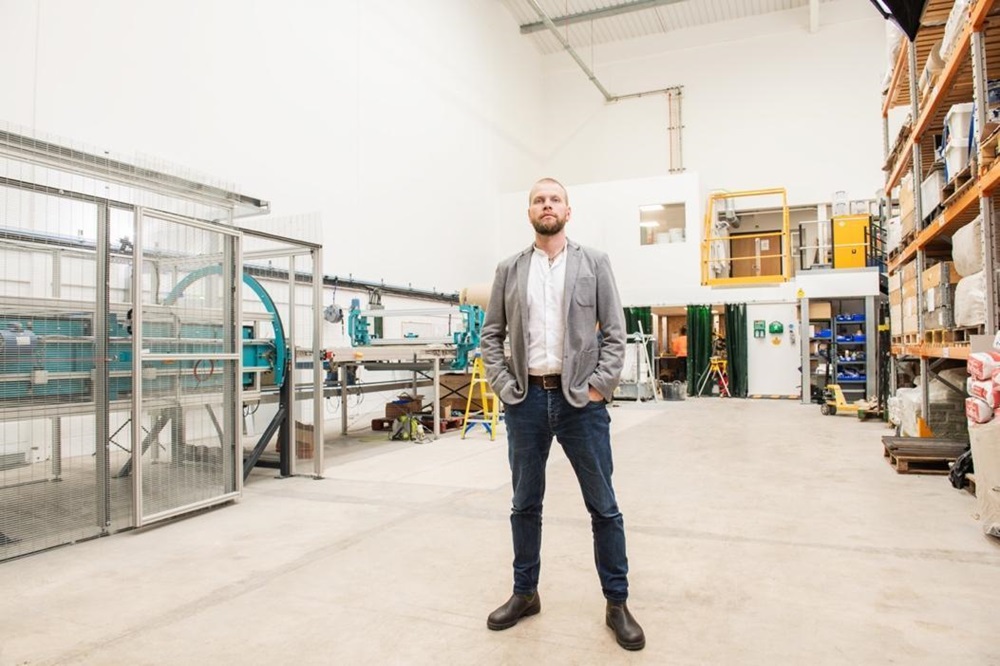
Main image: Adaptavate founder and chief executive, Tom Robinson stands in front of the new pilot line for low-carbon and carbon-negative plasterboard at the company’s Bristol HQ
Read next: “Bellingham Bridge” takes shape with rise of massive piers
Are you a building professional? Sign up for a FREE MEMBERSHIP to upload news stories, post job vacancies, and connect with colleagues on our secure social feed.
