
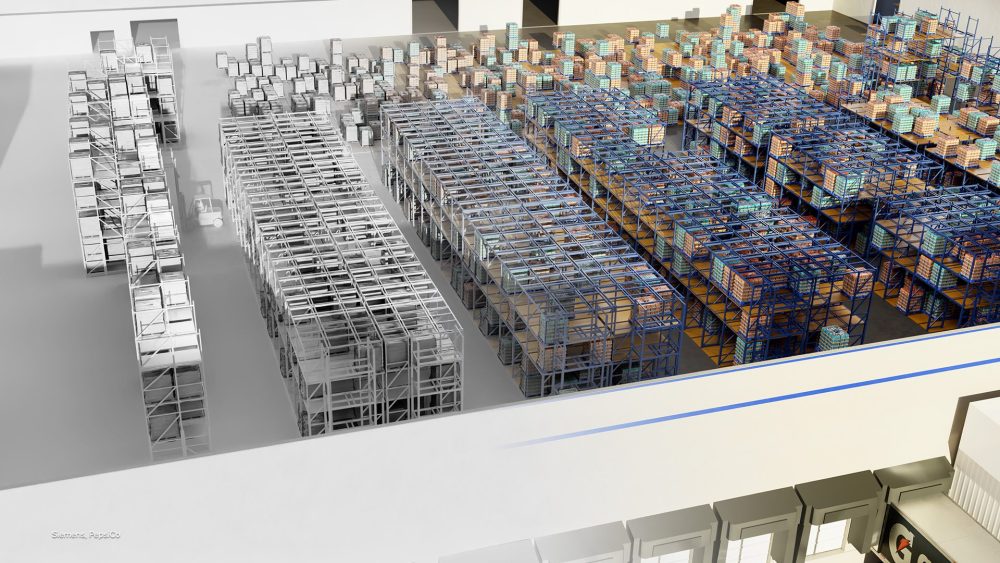
Siemens and NVIDIA have announced a major expansion of their long-standing partnership, setting out a shared ambition to develop what they describe as the Industrial AI operating system. The collaboration aims to move artificial intelligence from theoretical and digital applications into the physical world, supporting real-world industrial workflows across design, construction, manufacturing and operations. For the digital construction sector, the announcement signals a significant acceleration in the convergence of AI, digital twins, simulation and automation.
Under the expanded agreement, NVIDIA will provide advanced AI infrastructure, simulation libraries, models, frameworks and reference blueprints. Siemens, in turn, will contribute hundreds of industrial AI specialists alongside its established hardware, software, industrial data platforms and automation technologies. The combined approach is designed to scale industrial AI adoption while delivering practical outcomes across complex built and industrial environments.
Roland Busch, President and Chief Executive Officer of Siemens AG, framed the collaboration as a foundational shift in how the physical world is conceived and operated. “Together, we are building the Industrial AI operating system, redefining how the physical world is designed, built and run, to scale AI and create real-world impact,” he said. “By combining NVIDIA’s leadership in accelerated computing and AI platforms with Siemens’ leading hardware, software, industrial AI and data, we’re empowering customers to develop products faster with the most comprehensive digital twins, adapt production in real time and accelerate technologies from chips to AI factories.”
From NVIDIA’s perspective, the partnership reflects the growing maturity of generative AI and accelerated computing in industrial contexts. Jensen Huang, founder and CEO of NVIDIA, explained: “Generative AI and accelerated computing have ignited a new industrial revolution, transforming digital twins from passive simulations into the active intelligence of the physical world. Our partnership with Siemens fuses the world’s leading industrial software with NVIDIA’s full-stack AI platform to close the gap between ideas and reality, empowering industries to simulate complex systems in software, then seamlessly automate and operate them in the physical world.”
Accelerating the full industrial lifecycle
A core focus of the partnership is the application of AI-accelerated industrial solutions across the entire lifecycle of products and production systems. This includes early-stage design, construction planning, commissioning, operations and long-term optimisation. The companies intend to deliver faster innovation cycles, continuous performance improvement and more resilient, sustainable manufacturing and infrastructure assets.
One of the most notable initiatives is the plan to develop fully AI-driven, adaptive manufacturing sites, beginning in 2026 with the Siemens Electronics Factory in Erlangen, Germany. This facility will serve as the first global blueprint for AI-enabled production, integrating software-defined automation, industrial operations software and NVIDIA Omniverse libraries with high-performance AI infrastructure.
Central to this model is the concept of an ‘AI Brain’, which continuously analyses high-fidelity digital twins of factories and production lines. By testing improvements virtually and validating outcomes in simulation, operational changes can be deployed directly to the shopfloor with reduced risk. For digital construction and industrial delivery teams, this approach supports more informed decision-making, shorter commissioning periods and improved productivity from design through to deployment.
Several global organisations, including Foxconn, HD Hyundai, KION Group and PepsiCo, are already evaluating elements of these AI-driven capabilities, highlighting their relevance across multiple industrial and construction-adjacent sectors.
Advancing simulation, digital twins and generative engineering
As part of the expanded collaboration, Siemens will complete GPU acceleration across its entire simulation portfolio. Support for NVIDIA CUDA-X libraries and AI physics models will enable customers to run larger, more accurate simulations at significantly higher speeds. This has direct implications for digital construction workflows that rely on complex modelling of assets, systems and environments.
Building on this capability, the partners are advancing towards generative simulation using NVIDIA PhysicsNeMo and open models. The objective is to create autonomous digital twins capable of real-time engineering design, predictive analysis and autonomous optimisation. These AI-driven digital twins move beyond static representation, becoming active systems that support continuous performance improvement across infrastructure and industrial assets.
Electronic design automation and AI factories
The partnership also extends into electronic design automation and the development of next-generation AI factories. Siemens will integrate NVIDIA CUDA-X libraries, PhysicsNeMo and GPU acceleration across its EDA portfolio, targeting two-to-ten-times speed improvements in verification, layout and process optimisation workflows. AI-assisted design guidance, debugging and circuit optimisation will further enhance engineering productivity while maintaining manufacturability standards.
In parallel, Siemens and NVIDIA will jointly develop repeatable blueprints for AI factories, addressing high-density computing requirements for power, cooling, electrification and automation. These blueprints are intended to optimise the full lifecycle of AI infrastructure, from planning and design through to deployment and operations, with a strong emphasis on energy efficiency and resilience.
By combining industrial software, AI infrastructure and digital twins, Siemens and NVIDIA are setting a clear direction for scalable industrial AI adoption across digital construction and advanced manufacturing ecosystems worldwide.
Read next: AI trends that will actually matter in 2026 – Build in Digital
Are you a building professional? Sign up for a FREE MEMBERSHIP to upload news stories, post job vacancies, and connect with colleagues on our secure social feed.

