
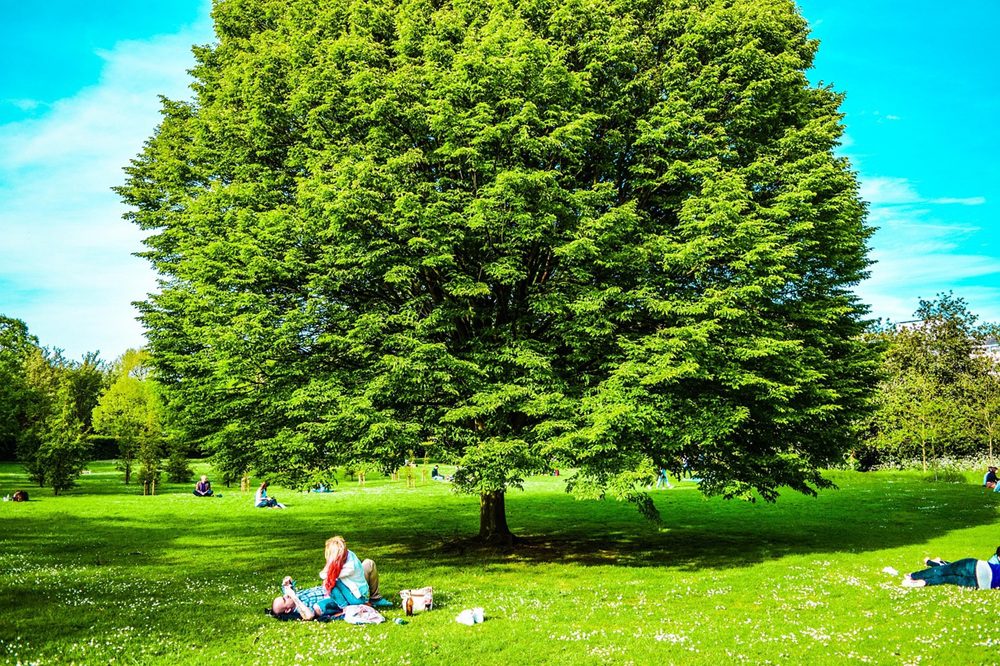
With house building a priority for the UK government, University of Bath engineers have co-authored research that urges city planners not to forget to build parks and to include green spaces in new communities to reduce air pollution.
Researchers in the faculty of engineering and design worked with partners led by the University of Surrey’s Global Centre for Clean Air Research (GCARE) on a new study that found parks are the most effective green, blue and grey infrastructure (GBGI) at reducing air pollution city-wide by up to 22%.
The study looked at the air pollution reduction capabilities and effectiveness of 51 different types of GBGI, such as trees, green walls, green roofs, hedges and parks.

The research is part of the RECLAIM project, a £1.45m UK Research and Innovation-funded Network+ initiative. It is led by GCARE in collaboration with Bath University, as well as the UK Centre for Ecology & Hydrology and the Universities of Bangor and Warwick.
Professor Prashant Kumar, lead author of the study and founding director of GCARE at the University of Surrey, and the director of RECLAIM, said: “We are beginning to understand just how powerful green infrastructure can be against urban air pollution, but their effectiveness hinges on where and how they are implemented. Our review has found that well-placed greenery can cut black carbon levels by up to 40%, making our communities greener and healthier.”
Dr Jannis Wenk, a senior lecturer in Bath’s Department of Chemical Engineering, and co-author of the study, said: “Urban environments, particularly streets, are at the forefront of climate change impacts and require effective pollution mitigation strategies across the UK.
Our role in field monitoring of green-blue infrastructure solutions, developing case studies, and integrating models for regional upscaling will help create more resilient, sustainable urban spaces that address immediate environmental concerns and benefit generations to come.”
The study, Air Pollution Abatement from Green-Blue-Grey Infrastructure, has beenpublished in the journal The Innovation Geoscience.
Image credit: summer kwak from Pixabay
Read next: BCIS reports tender prices up for civil engineering
Are you a building professional? Sign up for a FREE MEMBERSHIP to upload news stories, post job vacancies, and connect with colleagues on our secure social feed.
