
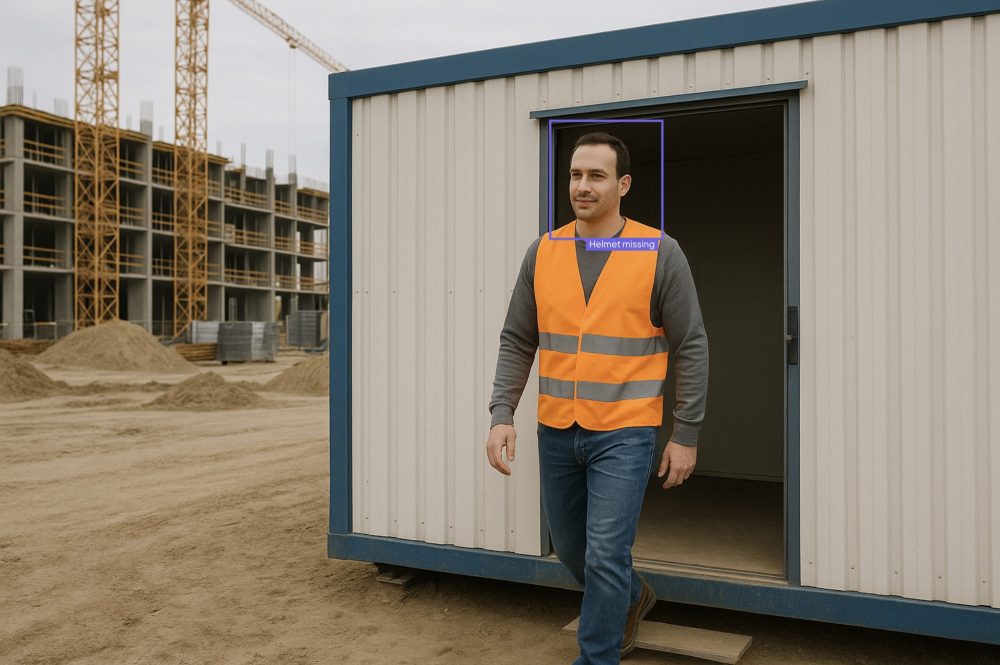
Safety remains a persistent challenge, and despite advances in training, auditing, and regulation, workplace incidents continue to occur. Traditional safety programmes often fail to prevent ongoing violations because they capture only brief snapshots of site conditions. Today, artificial intelligence (AI) and continuous monitoring are redefining how organisations detect, respond to, and ultimately prevent unsafe behaviour on site.
One example of this transformation comes from GREÏ, a technology company that has developed an AI-powered safety monitoring platform. Using existing site cameras, the GREÏ system provides real-time analytics to detect unsafe behaviours, from missing PPE to fall risks, and automatically alerts supervisors when action is needed. This combination of visibility, accountability, and instant intervention is proving critical as companies move towards a proactive, data-driven approach to safety management.
The limits of traditional safety programmes
Conventional safety programmes rely heavily on checklists, scheduled audits, and training sessions. While essential, these measures provide only a partial picture of what is actually happening on a live worksite. Conditions in construction and industrial environments change minute by minute, and hazards can appear or disappear in seconds. According to Health & Safety Executive (HSE), Britain’s national regulator for workplace health and safety, the construction sector has the highest number of fatal injuries.
“Regulations and training only go so far when real-time accountability is missing,” said Giedrė Rajuncė, CEO and Co-Founder of GREÏ. “Safety issues often occur not because workers don’t know the rules, but because organisations lack visibility into what’s happening in real time.”
Continuous monitoring: closing the visibility gap
Continuous monitoring through AI offers a step change in workplace safety. By connecting to existing CCTV infrastructure, platforms like GREÏ’s can analyse live video streams, detect unsafe actions, and alert site supervisors instantly. This enables companies to address issues before they escalate into incidents.
“As a general contractor, we’ve learned that checklists and periodic audits capture compliance for a moment in time, not the reality of a live site,” explained Egidijus Galinauskas, Head of Innovations and Development at Gilesta, a construction company currently piloting GREÏ’s AI system across three active sites.
Rajuncė highlighted the limitations of traditional oversight models: “On most sites, safety specialists are present for only a few hours each week, less than 10% of total working hours. That leaves the remaining 90% unmonitored, relying on trust. In a fast-changing environment, a lot can happen in that time. That’s exactly where the idea of a never-sleeping smart system was born.”
GREÏ’s AI-driven platform turns that idea into reality. Instead of relying on sporadic inspections, it transforms standard cameras into intelligent, always-on observers. The system identifies unsafe acts or environmental risks, triggers instant alerts, and compiles detailed analytics that help organisations understand and prevent recurring issues.
“AI closes that gap by turning our existing cameras into a 24/7 second set of eyes,” said Galinauskas. “It flags missing PPE or fall risks in real time, prompts supervisors to act, and gives us evidence to fix root causes rather than repeat violations.”


From reactive compliance to proactive prevention
The financial and operational impacts of unsafe workplaces are significant. Beyond regulatory fines, workplace incidents result in lost productivity, higher insurance premiums, and reputational damage. Traditional compliance frameworks often focus on responding to accidents after they occur, an inherently reactive approach.
By contrast, AI-powered continuous monitoring enables predictive and preventive safety management. Automated alerts, historical trend analysis, and data-backed insights help organisations identify recurring patterns and implement targeted interventions. For Gilesta, this means using GREÏ’s data to refine site layouts, enhance subcontractor briefings, and improve training where it is most needed.
“And we don’t stop at rollout, we turn the insights into concrete actions,” Galinauskas noted. “That includes targeted retraining, layout changes, and procedural updates. We also track the reduction in incidents as part of our ongoing safety routine.”
The future of safety is intelligent and integrated
Looking ahead, AI and digital construction technologies are set to redefine what safety management looks like. The next generation of platforms will not only detect unsafe behaviour but also predict risks based on environmental and operational data.
Rajuncė envisions a future where workplace safety evolves into workplace intelligence: “We’re heading towards a time when safety isn’t just a box to tick but an integral part of daily operations. Companies will use live dashboards, predictive alerts, and AI tools that integrate seamlessly into workflows. Managing risk will become as natural, and as automated, as running payroll.”
As digital construction continues to mature, the message is clear: visibility saves lives. Continuous AI-powered monitoring offers the real-time accountability and insight that conventional safety programmes have long lacked. By transforming reactive compliance into proactive prevention, systems like GREÏ’s are setting a new benchmark for safety in the built environment — one where technology works tirelessly to protect people, productivity, and performance.
Read next: Quality management is essential, yet uneven standards reduce profits – Build in Digital
Are you a building professional? Sign up for a FREE MEMBERSHIP to upload news stories, post job vacancies, and connect with colleagues on our secure social feed.

