
Digital construction harnesses AI twins delivering measurable, real-time building energy intelligence for global decarbonisation goals.
Reducing energy consumption in buildings has become central to global decarbonisation strategies, placing the construction and property sectors under increasing regulatory and operational pressure. Commercial offices, education estates, healthcare facilities, and public buildings all face tightening energy performance targets aligned with Zero-Energy Building (ZEB) delivery pathways.
However, traditional building energy modelling workflows rely on static simulation tools that struggle to capture changes in thermal loads and occupant comfort during design development. Designers often lack reliable, real-time feedback when testing HVAC strategies, leading to uncertainty in early-stage decision-making.
This limitation is particularly evident when implementing Task-Ambience Air Conditioning (TAAC) systems, where localised workspace cooling and overall room conditioning operate independently. Although TAAC systems can achieve operational energy savings, their performance has historically been assessed only after building completion.
A new AI-powered digital twin model now addresses this challenge by enabling real-time energy evaluation and comfort analysis directly within the design stage.
AI and VR combine to deliver real-time ZEB evaluation
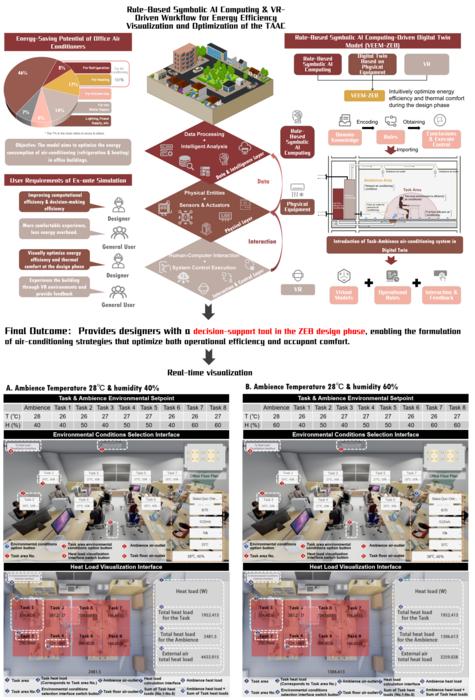
A research team led by Prof. Teng at Kanazawa University, working with collaborators from Fushou University, has developed VEEM-ZEB, a next-generation digital twin evaluation platform designed for smart building and ZEB development.
The model combines rule-based symbolic AI computing with immersive VR visualisation to allow simultaneous evaluation of building energy use and indoor thermal comfort during architectural design.
A defining feature of the VEEM-ZEB platform is the explicit separation of thermal loads from task conditioning and ambience conditioning. This enables designers to analyse HVAC control strategies while calculating comfort performance using internationally recognised PMV and PPD indices.
Integrated VR environments allow architects and engineers to visualise comfort levels and energy performance in real time while adjusting building parameters. Instead of waiting hours for simulation outputs, teams can now observe immediate changes as layouts, occupancy patterns, or system settings are modified.
This workflow introduces a practical decision-support mechanism aligned with digital construction and smart building design processes.

Large-scale scenario analysis improves HVAC decision-making
Another strength of the VEEM-ZEB system lies in its ability to automatically generate and assess large numbers of operating scenarios using standardised parameters. Approximately 48,000 design and operational combinations can be analysed, considering seasonal variation, occupancy density, and behavioural patterns.
Office-based demonstration studies showed measurable reductions in air-conditioning energy demand ranging from 7.0 to 8.5 percent, with average annual energy savings stabilising around 7.62 percent.
Importantly, the research allows TAAC performance, previously measurable only during operational use, to be evaluated before construction. Designers can therefore compare HVAC systems and control strategies quantitatively during early-stage development.
The platform’s three-layer architecture merges explainable rule-based AI computing, digital twin simulation, and VR-based visualisation, ensuring transparency and reproducibility in results. These qualities support adoption in professional building energy modelling and architectural environmental engineering workflows.
Applications across smart buildings
The implications for digital construction and smart building delivery are significant. Designers can now simultaneously evaluate energy consumption and indoor comfort before construction begins, allowing more informed decisions in pursuit of ZEB and net-zero building objectives.
The model supports diverse building typologies, including offices, educational environments, hospitals, and civic facilities. Early-stage performance assessment helps reduce operational energy consumption and long-term utility costs by encouraging efficient air-conditioning strategies before procurement and construction.
Beyond immediate project benefits, this development advances digital twin adoption across architectural environmental engineering research and professional practice. Integration of AI-driven energy modelling with immersive visualisation also aligns with wider industry transitions toward data-driven building performance design.
As digital construction workflows increasingly incorporate simulation, automation, and performance analytics, tools capable of delivering real-time insights will become essential to sustainable building delivery.
Adoption across digital construction will support net-zero strategies, guide evidence-based HVAC design, cut operational energy, and improve occupant comfort across future smart building portfolios worldwide safely globally.
Read next: Output, orders, costs and forecasts shaping 2026 – Build in Digital
Are you a building professional? Sign up for a FREE MEMBERSHIP to upload news stories, post job vacancies, and connect with colleagues on our secure social feed.
