
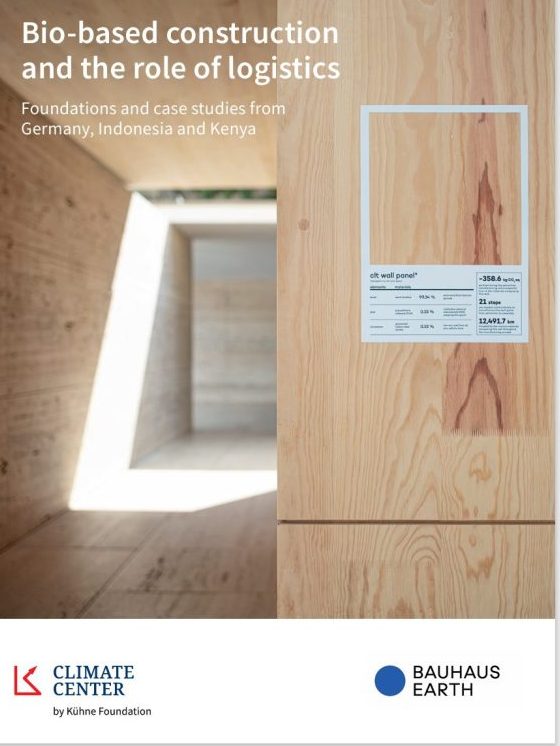
New research from Bauhaus Earth and the Kuehne Climate Center is calling for more efficient and better-connected supply chains to unlock the full potential of bio-based construction worldwide. Their findings underline a critical truth: without streamlined logistics and supply networks, the global transition to climate-positive building will remain out of reach.
The construction challenge
The construction sector is responsible for nearly 40% of global CO₂ emissions, with a significant portion stemming from the use of carbon-intensive materials, such as steel and concrete. With the global building stock expected to double by 2060, demand for sustainable alternatives has never been greater. Bio-based materials, including timber, bamboo and other plant-derived products, offer a promising route to drastically reduce emissions. They can even transform buildings into carbon sinks while promoting healthier, more natural environments.
The missing link: underdeveloped bio-based supply chains
The joint study, Bio-based Construction and the Role of Logistics, analysed supply chain performance across Germany, Kenya and Indonesia. It found that even in advanced markets, bio-based construction supply chains remain immature.
Effective forest management, industrialised material processing and the prefabrication of reusable modules are vital for scaling up production. However, the report highlights that regulatory barriers and inconsistent demand remain the biggest roadblocks.
“Research and innovation into bio-based building products is thriving,” said Dr Philipp Misselwitz, CEO of Bauhaus Earth. “But for companies to invest in large-scale, cost-efficient production, they need a clear and reliable market outlook.”
Dr Friederike Münn, CEO of Berlin-based B&O Bau u.GT, agrees: “The transition to bio-based construction depends on more than materials. It requires systemic change across processes, supply networks and policy frameworks. Only if demand, regulation and value-chain structures evolve together can timber construction become the standard for climate-conscious building.”


Supply chain inefficiencies inflate costs in emerging markets
In emerging markets, fragmented logistics and limited infrastructure are driving up costs. According to Olivia Lamenya from the Kuehne Climate Center’s Nairobi office, logistics account for nearly half of the total cost of timber in Kenya.
George A. Ndege, President of the Architectural Association of Kenya, believes that improving logistics could be transformative: “Integrated value chains for bio-based materials can make construction more affordable, accessible and sustainable.” Local initiatives such as Grow a Classroom (GAC) and the Safari Green Building Index (SGBI) are already advancing sustainable timber production and green certification.
The study also examined bamboo construction in Indonesia, where high material costs are largely the result of inefficient production techniques.
Long-distance supply chains can still be climate-positive
A common misconception is that transporting timber across long distances negates its environmental benefits. The research challenges this assumption. “Green timber can travel up to 3,000 km by truck or 12,000 km by ship and still outperform locally sourced concrete in terms of carbon footprint,” explained Hannah Langmaack from Bauhaus Earth.
This flexibility means that bio-based construction materials can be sourced globally, not just locally, allowing regions without native resources to participate in the low-carbon transition while supporting trade and innovation.
Building the foundations for change
“Efficient supply chains and logistics are only one piece of the puzzle,” said Stefanie Sohm from the Kuehne Climate Center. “But they are critical to unlocking the potential of bio-based buildings. We are developing the data and tools that help supply chain actors make better decisions and accelerate the adoption of climate-positive construction.”
The full report – Bio-based Construction and the Role of Logistics: Foundations and Case Studies from Germany, Kenya and Indonesia – is available now.
Read next: New British standard on sustainability competence – Build in Digital
Are you a building professional? Sign up for a FREE MEMBERSHIP to upload news stories, post job vacancies, and connect with colleagues on our secure social feed.