
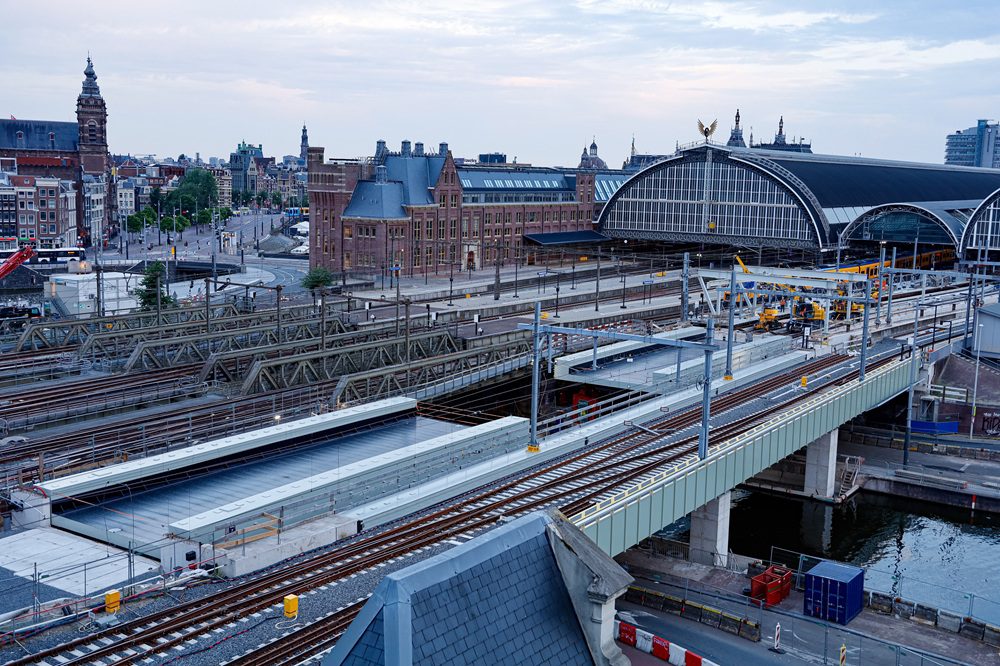
Mammoet has finished the second of five bridge replacements at Amsterdam Centraal Station, part of a multi-year rail infrastructure programme.
The work follows the company’s completion of the first bridge replacement in 2025 and forms part of the high-frequency rail transport programme, led by ProRail. The programme covers track optimisations, infrastructure adjustments and civil work inside the station building, with the aim of enabling more trains to run to and from the station in future.
Working alongside construction company Dura Vermeer, Mammoet managed the load-out, transportation and installation of three steel deck sections manufactured by Hollandia Infra that make up the second bridge – two outer components of 28.5 metres and 275 tonnes each, and a middle section of 21 metres and 175 tonnes.

Because the station sits in a busy capital city, transporting the new bridge sections to site presented a complex engineering and logistical challenge. Mammoet’s solution was to move the sections by water rather than road, minimising disruption and allowing the station to remain open throughout the works.
Each section was delivered to the Oostertoegang side of the station on a flat-top barge, which was partially submerged to pass underneath a low footbridge. Once in position, the sections were rotated 90 degrees using Mammoet self-propelled modular transporters (SPMTs), before being jacked up with specialist lifting equipment.
The first bridge replacement had used Mammoet’s Mega Jack 300 system for the final jacking operation on the centre section. A different method was required this time, with less space available for the sections to manoeuvre.
Leo de Vette, project manager at Mammoet, said: “Previously, we used our Mega Jack 300 system and SPMTs to lift and rotate all deck sections on the deck of the barge and then drive them off and into position. This time, however, we are working between two bridges, so we had to consider the decks and columns of the old bridges, as well as those of the new bridge we installed last year. For this reason, we had to first manoeuvre and rotate the new sections underneath these bridges and then jack them up using a four-point lifting system, which was assembled on the quayside.”
The four-point lifting system uses four large hydraulic cylinders that extend at the same speed and sit inside tracks, allowing precise movement and lifting.
For the final central section, the supporting pile was built only after the span had been roughly positioned. The section was floated into place at right angles to the installation direction, rotated 90 degrees and lifted, before being set down on consoles on the two already-installed sections. The central column was then built, and Mammoet returned to lower the centre section onto it.
Each bridge section took approximately one week to install.
Read next: Jewson leads campaign to save UK’s construction industry
Are you a building professional? Sign up for a FREE MEMBERSHIP to upload news stories, post job vacancies, and connect with colleagues on our secure social feed.
