
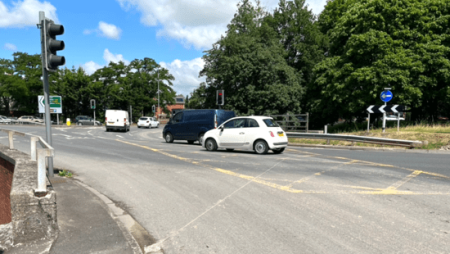
National Highways has unveiled the first phase of a £23 million investment programme to improve the A36 through Salisbury, a key strategic route linking the south coast with Bristol, Bath and London. The six-year programme will begin in early 2026 with targeted interventions designed to address congestion, safety, and journey time reliability using modern digital construction and intelligent transport systems.
The initial scheme focuses on improving traffic flows around the St Paul’s, St Mark’s and Castle roundabouts, which currently rely on 32-year-old signal infrastructure that has reached the end of its operational life. These legacy systems will be replaced with adaptive traffic signals that respond dynamically to real-time vehicle demand rather than operating on fixed timings. This smart traffic management approach reflects wider National Highways investment in digital road infrastructure and data-led network operations.
Works will commence on 19 January, with adaptive signal installations at the Castle and St Mark’s roundabouts. A similar upgrade is scheduled for the St Paul’s roundabout in early summer. The first phase will take approximately 11 weeks, followed by the second phase between 1 June and 27 July. Essential resurfacing at the Castle and St Paul’s roundabouts, as well as Wilton Road, is planned between 14 and 31 July.
Beyond traffic signal modernisation, further A36 road improvements will be delivered in phases over the coming years. These include resurfacing works, improved road markings, pavement renewal, upgrades to the Southampton Road pedestrian crossing, strengthening of the Maltings access bridge, repairs to the Avon River bridge, and replacement of the Victoria Road footbridge to improve accessibility. The Wyndham Road footbridge will be removed while alternative options are assessed.
Importance of the scheme
Chris Hilldrup, Route Manager at National Highways, highlighted the importance of the scheme, stating: “The A36 is the main arterial route through Salisbury, carrying an average of 33,500 vehicles a day between the College and St Mark’s roundabouts, and helps connect the south coast with Bristol, Bath and London. Given insurmountable limitations on constructing a bypass for the city, we must continue to maintain and improve the route.”
He added that the investment will “reduce congestion, improve safety, create more reliable journey times and ultimately support Salisbury’s long-term economic growth,” aligning infrastructure delivery with wider regional economic objectives.
Maria Testa Borjon, National Highways Project Manager, emphasised the collaborative planning behind the works. “We’re carefully planning the programme with Wiltshire Council, Salisbury City Council and Southern Gas Networks, who are carrying out major gas mains renewals along the A36,” she said. “We’re working closely with our partners to keep disruption to a minimum.”
For safety reasons, single-lane and full closures will be required during daytime and overnight works, with signed diversions in place. To minimise impact, the most disruptive activities have been scheduled to avoid Salisbury’s 2027 Royal Charter celebrations.
By combining adaptive traffic technology, phased delivery and collaborative planning, the A36 Salisbury improvements demonstrate how digital construction can enhance network performance while supporting long-term regional connectivity and economic resilience.
Read next: Landmark construction skills partnership launched – Build in Digital
Read next: Are you a building professional? Sign up for a FREE MEMBERSHIP to upload news stories, post job vacancies, and connect with colleagues on our secure social feed.

