
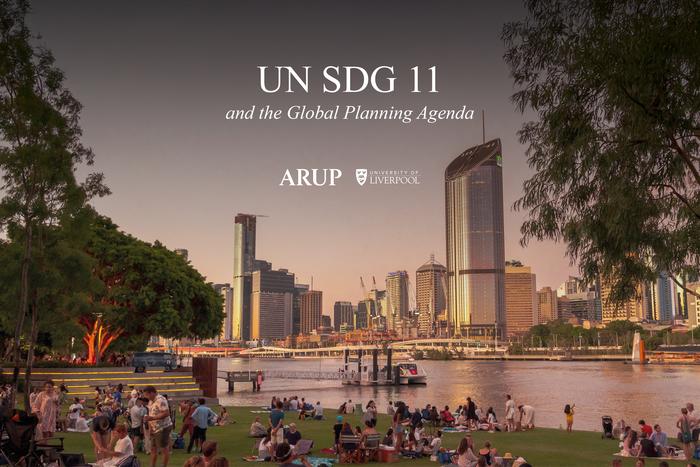
A new international report has urged the global planning community to move ‘from awareness to action’ if the United Nations’ Sustainable Development Goal 11 (SDG 11) sustainable, inclusive, safe, and resilient cities is to be achieved by 2030.
The study, UN SDG 11 and the Global Planning Agenda, was produced by researchers from the University of Liverpool’s Department of Geography & Planning and global built environment consultancy Arup. Drawing on a global literature review, data from Arup’s international planning network, interviews with planning professionals across 15 countries, and a panel discussion with leading planning institutes at the RTPI Planning Conference 2025, the report offers a comprehensive picture of how SDG 11 is shaping planning systems around the world.
While awareness of SDG 11 is widespread, the research found that its influence on urban planning practices remains inconsistent. In many cases, the goal’s principles are being applied implicitly rather than through explicit integration into planning policy and governance. The report concludes that for cities to become genuinely sustainable, planners must embed the SDGs more directly into education, regulation, and day-to-day practice.
Global awareness, local application
The report identifies several key findings that reveal both progress and gaps in the integration of SDG 11. While developing countries tend to rely more heavily on the SDGs to inform planning frameworks, many wealthier nations demonstrate implicit rather than formal application. The study highlights that the capacity for data collection and monitoring is relatively strong across many regions but often fails to translate into meaningful on-the-ground implementation.
Engagement with SDG 11 is also influenced by a variety of motivations, including institutional image, political reputation, and access to international funding. The report notes that effective implementation often combines top-down guidance from governments with bottom-up and horizontal collaboration between local authorities, communities, and private stakeholders.
These dynamics underline a crucial point for the global planning profession: awareness alone will not deliver the transformation needed for sustainable urbanisation. Translating the UN’s high-level goals into tangible planning actions requires a deliberate shift towards application and measurement.
Why this matters for urban planners
According to the report, planners are uniquely positioned to turn global sustainability commitments into real-world outcomes. They operate at the intersection of land use, infrastructure, environment, and social equity, all areas directly influenced by SDG 11.
The authors argue that planning systems must be adequately supported to deliver on this potential. This includes greater investment in professional capacity-building, clearer policy frameworks aligned with the SDGs, and stronger mechanisms for sharing best practices internationally.
Highlighting how planning contributes to global sustainability goals also strengthens the profession’s legitimacy. As the report points out, embedding the language of SDG 11 within planning practice can engage younger generations and attract new talent into the sector. Measuring how planning decisions advance SDG objectives provides accountability and demonstrates the value of planning to wider society.
Dr Olivier Sykes, Senior Lecturer in European Spatial Planning at the University of Liverpool, emphasised the importance of translating awareness into local action: “UN SDG 11 should be shaping planning cultures worldwide, but our research shows it’s doing so largely through implicit influence. If we’re serious about achieving inclusive, safe, resilient and sustainable cities by 2030, we must embed the SDGs in education, policy frameworks, and everyday professional practice.”
Jane Healey Brown, Director at Arup Manchester, added that explicit application provides a valuable means of demonstrating impact: “UN SDG 11 offers planners a framework for global best practice sharing. Explicit integration is essential because it provides measurable evidence of how planning is delivering positive change. Planners would benefit from a stronger toolkit with practical examples of how to integrate the goals and empower delivery.”
From aspiration to implementation
Since the adoption of the 17 United Nations Sustainable Development Goals in 2015, SDG 11 has become a central reference point for those involved in city-making and spatial planning. It calls for cities and communities that are inclusive, safe, resilient, and sustainable, ambitions that lie at the heart of the planning profession.
However, as this latest research shows, the challenge lies in ensuring that the principles of SDG 11 are not merely acknowledged but systematically applied. Strengthening the link between global goals and local planning action will be vital to meeting the 2030 deadline.
The report’s authors stress that partnerships between academia, industry, and professional institutes are essential to bridging this gap. By aligning planning education, professional development, and policy frameworks with SDG 11, the global community can make meaningful progress toward sustainable urban futures. The full report, UN SDG 11 and the Global Planning Agenda, is available from the University of Liverpool’s website: https://www.liverpool.ac.uk/media/livacuk/schoolofenvironmentalsciences/geographyandplanning/research/UNSDG,FInal,Report.pdf
Read next: Environmental impact of AI data centre boom – Build in Digital
Are you a building professional? Sign up for a FREE MEMBERSHIP to upload news stories, post job vacancies, and connect with colleagues on our secure social feed.\

