
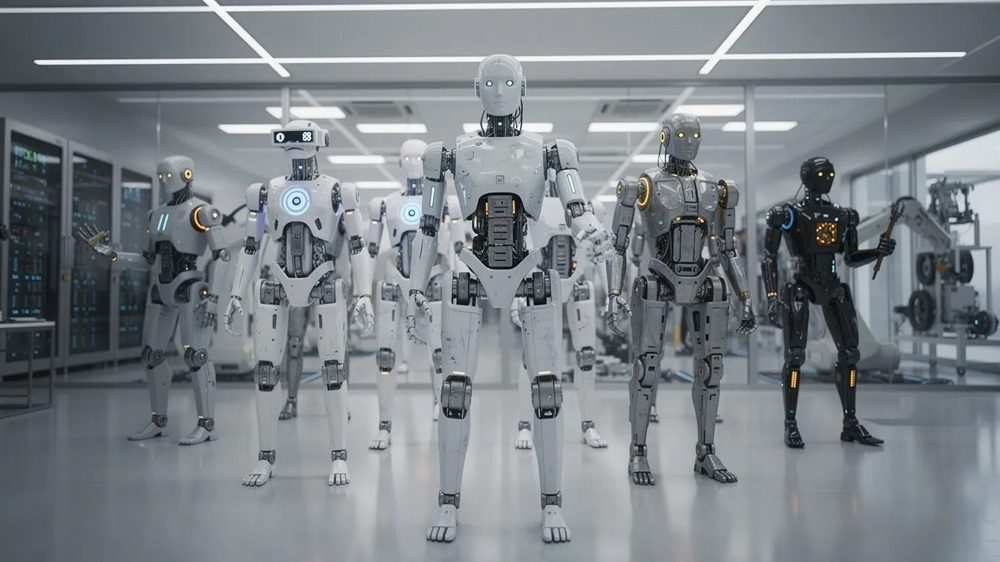
German cognitive robotics firm NEURA Robotics has closed a Series C financing round of up to $1.4bn – the largest ever raised by a full-stack robotics company.
The deal brings together a broad coalition of technology, industrial and financial backers including Tether, Qualcomm Technologies, Amazon, NVIDIA, Bosch, Schaeffler, the European Investment Bank, imec.xpand, Lingotto Horizon and InterAlpen Partners.
The company says its existing order book and strategic deployment pipeline already exceed $1bn.
The round signals growing investor conviction in physical AI – the convergence of robotics, artificial intelligence and real-world sensing infrastructure – as a distinct technology category rather than an extension of conventional automation.

Founded in 2019 and headquartered in Metzingen, Germany, Neura Robotics develops cognitive robots capable of perceiving and responding to their environment, alongside the software, AI models and data infrastructure needed to deploy them at scale.
The company positions itself not as a maker of standalone industrial machines, but as the builder of a unified platform architecture for intelligent machines operating across multiple real-world environments.
Into the Neuraverse
Central to that platform is what the company calls the Neuraverse – a shared intelligence ecosystem through which cognitive robots continuously exchange learned skills, capabilities and data across deployments. The ambition is to create an open ecosystem in which humanoid and non-humanoid robots collectively improve over time, rather than operating in isolation.
David Reger, founder and chief executive of NEURA Robotics, said: “The future of AI will not only live on screens. It will move, interact, learn and work beside us in the real world. We believe physical AI and cognitive robotics will become one of the largest technology shifts of the coming decades, transforming industries ranging from manufacturing and logistics to healthcare, services and household robotics.”
The new capital will be deployed across several priorities: global rollout of cognitive robots and humanoids, expansion of the Neuraverse platform, scaling of manufacturing capacity toward multi-million unit production by 2030, and the development of what the company calls NEURA Gyms – large-scale, real-world training environments designed to generate robotics data at scale through a combination of physical sensor interaction, simulation and multimodal learning pipelines.
The NEURA Gym concept represents an attempt to solve one of the central bottlenecks in physical AI development: the shortage of high-quality, real-world training data for robots operating in unstructured environments.
Unlike data centres serving large language models, robots require exposure to physical variability – surfaces, forces, spatial relationships – that cannot easily be synthesised.
Nafea Bshara, vice president and distinguished engineer at Amazon, described the investment as “a natural extension of our strategic partnership with NEURA Robotics and our shared conviction in the transformative potential of physical AI,” adding that Amazon would contribute cloud infrastructure and AI tooling – including its Bedrock and SageMaker platforms and purpose-built chips – to support deployment at scale.
Qualcomm Technologies, which is contributing edge compute and connectivity capabilities to the Neuraverse platform, framed the investment in terms of the demands physical AI places on on-device processing.
“Robotics is one of the most demanding edge AI use cases, where systems must perceive, reason and act instantly, reliably, and on device for safety-critical applications,” said Nakul Duggal, executive vice president and group general manager for automotive, industrial and embedded IoT, and robotics at Qualcomm Technologies.
Technological autonomy
For European investors and institutions, the round carries a broader strategic dimension. The European Investment Bank – which backed NEURA through its TechEU programme for high-growth European technology companies – framed the investment in terms of the continent’s technological autonomy.
“By backing NEURA Robotics, the European Investment Bank is putting serious European firepower behind the next wave of physical AI and cognitive robotics,” said Nicola Beer, vice president of the European Investment Bank.
Reger added: “Many believed globally relevant AI infrastructure companies could only emerge from Silicon Valley. We believe the next generation of AI leaders can emerge anywhere in the world where there is enough vision, engineering talent and execution speed. With this financing, NEURA is firmly among the global leaders in the robotics race, alongside the best in the US and China.”
Industrial partners Bosch and Schaeffler – both investors as well as technology collaborators – bring sensor technology, precision manufacturing and mechanical components expertise to the partnership.
Stefan Hartung, chief executive of Robert Bosch GmbH, cited “significant growth opportunities in the field of humanoid robotics,” while Klaus Rosenfeld, chief executive of Schaeffler AG, pointed to the company’s mechanical engineering heritage as a differentiator in the humanoid space.
The company’s stated production target – scaling to multi-million robots by 2030 – is a significant step-up from current deployment levels, and will require the manufacturing and logistics infrastructure to match.
“In the future, people will not only ask what AI can say,” said Reger. “They will ask what AI can physically do.”
Image credit: Shutterstock Gen AI
Read next: Call for public inquiry to secure UK steel’s future
Are you a building professional? Sign up for a FREE MEMBERSHIP to upload news stories, post job vacancies, and connect with colleagues on our secure social feed.
