
Scientists in the United States have developed a more effective filtration process that reduces the hazardous waste generated during the production of aluminium.
The material is widely used in the construction sector because of its light-weight durability and corrosion resistant properties.
Indeed, it has widespread applications through a range of sectors and uses, from kitchen foil to circuit boards and rocket boosters. It is the second most produced metal in the world after steel.
By the end of this decade, demand is projected to drive up aluminium production by 40% worldwide. This steep rise will magnify aluminium’s environmental impacts, including any pollutants that are released with its manufacturing waste.
However, engineers at the Massachusetts Institute of Technology (MIT) have developed a new nano-filtration process to curb the hazardous waste generated from aluminium production.
They say that the process could potentially be used to process the waste from an aluminium plant and retrieve any aluminium ions that would otherwise have escaped in the effluent stream. The captured aluminium could then be upcycled and added to the bulk of the produced metal, increasing yield while simultaneously reducing waste.

John Lienhard, the Abdul Latif Jameel professor of water in the Department of Mechanical Engineering, and director of the Abdul Latif Jameel Water and Food Systems Lab (J-WAFS) at MIT, said: “This membrane technology not only cuts down on hazardous waste but also enables a circular economy for aluminium by reducing the need for new mining. This offers a promising solution to address environmental concerns while meeting the growing demand for aluminium.”
Lienhard and his research team published their results in the journal, ACS Sustainable Chemistry and Engineering.
The researchers demonstrated the membrane’s performance in lab-scale experiments using a novel membrane to filter various solutions that were similar in content to the waste streams produced by aluminium plants. They found that the membrane selectively captured more than 99% of the metal’s ions in these solutions.
If scaled up and implemented in existing production facilities, the team says, then the membrane technology could reduce the amount of wasted aluminium and improve the environmental quality of the waste that plants generate.
Making metal
As part of aluminium’s production, an ore called bauxite is first mined from open pits, then put through a series of chemical reactions to separate the aluminium from the rest of the mined rock. These reactions ultimately produce aluminium oxide, in a powdery form called alumina. Much of this alumina is then shipped to refineries, where the powder is poured into electrolysis vats containing a molten mineral called cryolite.
When a strong electric current is applied, cryolite breaks alumina’s chemical bonds, separating aluminium and oxygen atoms. The pure aluminium then settles in liquid form to the bottom of the vat, where it can be collected and cast into various forms.
Cryolite electrolyte acts as a solvent, facilitating the separation of alumina during the molten salt electrolysis process. Over time, the cryolite accumulates impurities such as sodium, lithium, and potassium ions – gradually reducing its effectiveness in dissolving alumina.
At a certain point, the concentration of these impurities reaches a critical level, at which the electrolyte must be replaced with fresh cryolite to main process efficiency. The spent cryolite, a viscous sludge containing residual aluminium ions and impurities, is then transported away for disposal.
Lead author, Trent Lee said: “We learned that for a traditional aluminium plant, something like 2,800 tonnes of aluminium are wasted per year. We were looking at ways that the industry can be more efficient, and we found cryolite waste hadn’t been well-researched in terms of recycling some of its waste products.”
In their new work, the researchers aimed to develop a membrane process to filter cryolite waste and recover aluminium ions that inevitably make it into the waste stream. Specifically, the team looked to capture aluminium while letting through all other ions, especially sodium, which builds up significantly in the cryolite over time.
The team reasoned that if they could selectively capture aluminium from cryolite waste, the aluminium could be poured back into the electrolysis vat without adding excessive sodium that would further slow the electrolysis process.

Seawater inspiration
The researchers’ new design is an adaptation of membranes used in conventional water treatment plants. These membranes are typically made from a thin sheet of polymer material that is perforated by tiny, nanometer-scale pores, the size of which is tuned to let through specific ions and molecules.
The surface of conventional membranes carries a natural, negative charge. As a result, the membranes repel any ions that carry the same negative charge, while they attract positively charged ions to flow through.
In collaboration with the Japanese membrane company Nitto Denko, the MIT team sought to examine the efficacy of commercially available membranes that could filter through most positively charged ions in cryolite wastewater while repelling and capturing aluminum ions.
However, aluminum ions also carry a positive charge, of +3, where sodium and the other cations carry a lesser positive charge of +1.
Motivated by the group’s recent work investigating membranes for recovering lithium from salt lakes and spent batteries, the team tested a novel Nitto Denko membrane with a thin, positively charged coating covering the membrane. The coating’s charge is just positive enough to strongly repel and retain aluminium while allowing less positively charged ions to flow through.
Co-author Zi HaoFoo, who is a postdoc at the University of California at Berkeley, said: “The aluminium is the most positively charged of the ions, so most of it is kicked away from the membrane.”
The team tested the membrane’s performance by passing through solutions with various balances of ions, similar to what can be found in cryolite waste. They observed that the membrane consistently captured 99.5% of aluminium ions while allowing through sodium and the others. They also varied the pH of the solutions, and found the membrane maintained its performance even after sitting in highly acidic solution for several weeks.
Foo added: “A lot of this cryolite waste stream comes at different levels of acidity. And we found the membrane works really well, even within the harsh conditions that we would expect.”
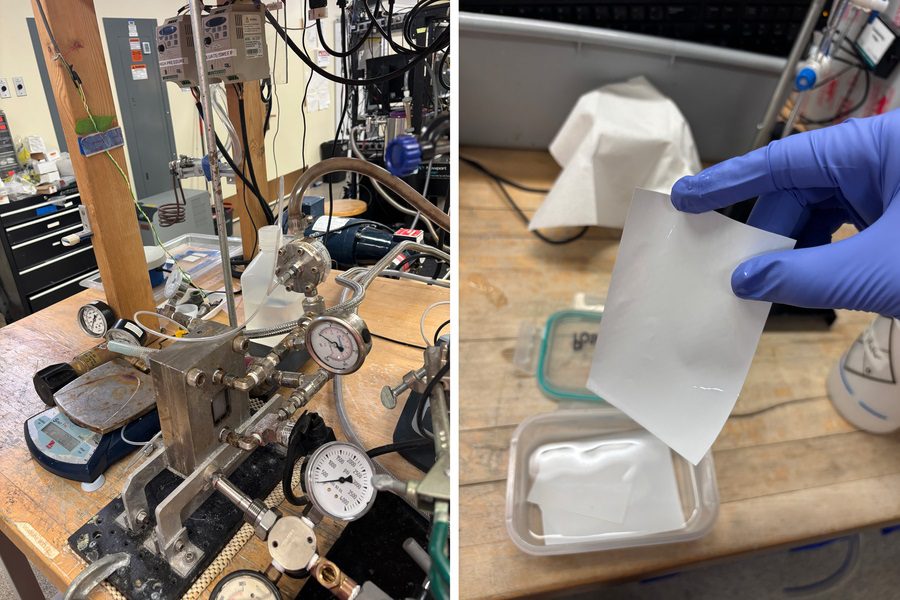
The new experimental membrane is about the size of a playing card. To treat cryolite waste in an industrial-scale aluminium production plant, the researchers envision a scaled-up version of the membrane, similar to what is used in many desalination plants, where a long membrane is rolled up in a spiral configuration, through which water flows.
Lee said: “This paper shows the viability of membranes for innovations in circular economies. This membrane provides the dual benefit of upcycling aluminium while reducing hazardous waste.”
Main image: Lab experiments with the novel membrane filter. Credit: Trent Lee/MIT
Read next: Paul Devlin named Causeway Technologies’ new chief
Are you a building professional? Sign up for a FREE MEMBERSHIP to upload news stories, post job vacancies, and connect with colleagues on our secure social feed.
