
The announcement by NVIDIA that it is partnering with the U.S. Department of Energy (DOE) and other leading organisations to build advanced AI infrastructure is poised to change how we conceive, design and deliver built-environment projects. This major initiative signals a blueprint to power the next industrial revolution, ushering in game-changing digital construction capabilities, AI-driven component manufacturing, and smart infrastructure that thrives on accelerated computing. For professionals in the digital construction sector, understanding how this infrastructure will ripple through architecture, engineering, modular build and asset lifecycle is critical.
Advancing AI infrastructure
NVIDIA’s strategy centres on delivering AI infrastructure at scale, in collaboration with U.S. national laboratories and industry partners. According to NVIDIA it is accelerating seven new systems across the DOE’s network, including both Argonne National Laboratory and Los Alamos National Laboratory.
- At Argonne, the “Solstice” system will consist of 100,000 NVIDIA Blackwell GPUs; the “Equinox” system will deliver a further 10,000 Blackwell GPUs, and both are interconnected to deliver an aggregated 2,200 exaflops of AI performance.
- At Los Alamos, the Vera Rubin platform and Quantum-X800 InfiniBand networking fabric will underpin “Mission” and “Vision” systems for simulation, national security, materials science and advanced manufacturing.
For the digital construction sector, the relevance is significant: such infrastructure enables high-fidelity digital twin models, generative design at scale, real-time simulation of energy, power, cooling and structural systems, and precise computation for building the “factory” of the future.
From AI factory blueprint to industrial-scale build-outs
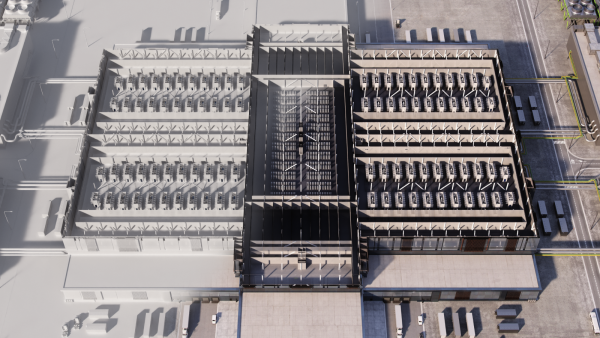
One of the most relevant facets for built environment professionals is the blueprint that NVIDIA is establishing through its AI Factory Research Centre at Digital Realty in Virginia, powered by the Vera Rubin platform and the architecture of the NVIDIA Omniverse DSX.
This facility serves as a prototype for multi-generation, gigawatt-scale build-outs using Omniverse libraries, integrating virtual and physical systems, and optimising for energy efficiency and performance.
For the construction and digital engineering industries, this model offers several important take-aways:
- Modular design of infrastructure with validated digital twins (architecture, power, mechanical, electrical systems) that mimic real-world performance and can iterate rapidly.
- Integration of power, cooling and energy equipment in simulation earlier in the design phase, enabling construction of intelligent facilities that react dynamically to loads, grid interaction and energy constraints.
- Use of AI agents and analytics to optimise lifecycle performance of infrastructure—not just the build phase, but the operation, maintenance and retro-fits of major assets.
In practical terms, this means a shift from conventional design-bid-build to data-driven, digitally integrated building factories where construction and operation converge.


Implications for digital construction and smart infrastructure
For stakeholders in digital construction, architects, engineers, contractors, operations managers, BIM practitioners, the implications are rich:
- Enhanced digital twin maturity: With access to high-performance AI infrastructure, digital twins can become live, learning systems rather than static models. Simulations of structure-energy-fluid flows will be executed in near real-time, enabling risk-mitigation, scenario testing and performance optimisation.
- Advanced manufacturing and modular build: The blueprint for AI factories points directly to “smart factories” producing modules or components for built environments. Construction companies will need to adapt to data-centric manufacture, just-in-time assembly and more responsive supply chains.
- Energy efficiency and sustainability by design: The computing infrastructure addresses cooling, power conversion, and system interaction at scale. Buildings and facilities will be designed from day-one with energy performance deeply coupled to AI-driven systems, enabling smarter, greener infrastructure.
- New skills and workflows: Digital construction teams must evolve. Skills in AI-driven simulation, digital twin management, systems integration and lifecycle analytics will be vital. The infrastructure build-out acts as a catalyst for those changes.
- Competitive positioning and strategic value: For firms in the UK and Europe, watching the US invest heavily in AI infrastructure provides a competitive benchmark. To remain relevant globally, digital construction service providers must articulate how they can integrate with these next-generation systems and deliver value across the built environment lifecycle.
Blueprint to power
The announcement by NVIDIA, in partnership with the DOE and leading technology firms, marks a strategic inflection point, which they call a blueprint to power the next industrial revolution. For the digital construction sector, this is a moment to pay attention. The rise of AI infrastructure, gigawatt scale, modular build, digital twin orchestration and life-cycle optimisation is set to transform how we conceive, deliver and manage built environments.
By aligning design, construction and operation around AI-driven infrastructure, organisations could lead the shift from buildings to intelligent systems, from one-off projects to sustained asset ecosystems. The next industrial revolution will not merely build factories, it will build smart, responsive infrastructure at scale, and digital construction must be ready.
Read next: Powering the future of smart and sustainable construction – Build in Digital
Are you a building professional? Sign up for a FREE MEMBERSHIP to upload news stories, post job vacancies, and connect with colleagues on our secure social feed.
