
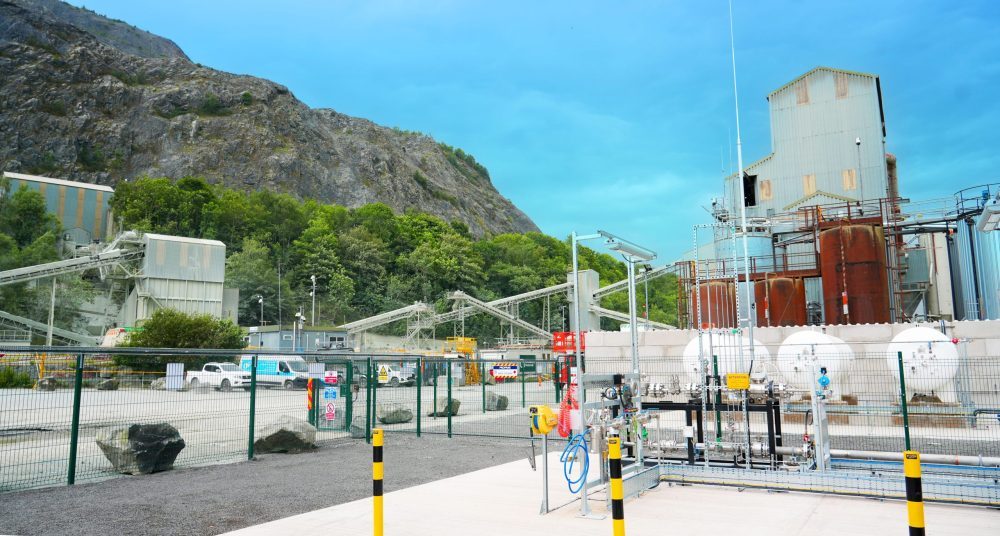
Heidelberg Materials has completed the UK’s first industrial-scale hydrogen-fuelled asphalt production trial at its Criggion plant.
Heidelberg Materials has completed the UK’s first successful trial using 100 per cent hydrogen to power asphalt production. The project took place at the company’s Criggion asphalt plant in Powys, mid Wales, marking a milestone for low-carbon infrastructure materials and digital construction supply chains.
The initiative forms part of the UK Government’s Industrial Hydrogen Accelerator programme and received part-funding from the Department for Energy Security and Net Zero (DESNZ). Developed over three years, the trial demonstrates how hydrogen fuel switching can reduce emissions within asphalt manufacturing processes.
Hydrogen replaced liquid fossil fuels during production, enabling the facility to manufacture 1,303 tonnes of asphalt without affecting the material’s quality or performance. The results highlight the potential of hydrogen energy in heavy industry where electrification remains technically complex.

Carbon reduction achieved in hydrogen asphalt manufacturing
During the trial, the plant used 4,522kg of hydrogen to produce asphalt. This substitution reduced direct Scope 1 emissions by 76 per cent and lowered the overall carbon footprint of the asphalt by 23 per cent. In total, the project prevented 25,105kg of CO₂ emissions.
If hydrogen-fuelled asphalt production were implemented across the UK asphalt sector, potential emissions savings could reach 450,000 tonnes of CO₂ annually. Such reductions are significant for the construction industry’s decarbonisation targets and support broader digital construction strategies that integrate sustainability data into infrastructure planning.
Simon Willis, CEO of Heidelberg Materials UK, emphasised the importance of exploring multiple decarbonisation strategies.
“We need to consider carbon reduction measures across all areas of our operations,” he said. “Fuel switching to hydrogen is one of these along with, for example, the development of carbon capture and storage, the use of alternative and secondary materials, and developing circular solutions.”
He added that hydrogen offers a pathway for decarbonising industries where electrification remains difficult. “Hydrogen will be a vital solution to decarbonise heavy industry where electrification is difficult and this successful demonstration of its potential to produce low carbon asphalt for the construction industry is a major step forward.”
Hydrogen’s role in the future construction supply chain
The company is also a member of Made with Hydrogen, a consortium advocating hydrogen adoption across manufacturing sectors producing essential materials including construction products. The group is calling for clearer policy direction to support hydrogen deployment and protect UK industrial competitiveness.
Hydrogen-fuelled asphalt production at Criggion demonstrates a viable pathway to decarbonise construction materials manufacturing, supporting net zero targets while maintaining performance, scalability and resilience across the UK infrastructure supply chain.
Read next: The AI-powered build in the future of construction – Build in Digital
Are you a building professional? Sign up for a FREE MEMBERSHIP to upload news stories, post job vacancies, and connect with colleagues on our secure social feed.
