
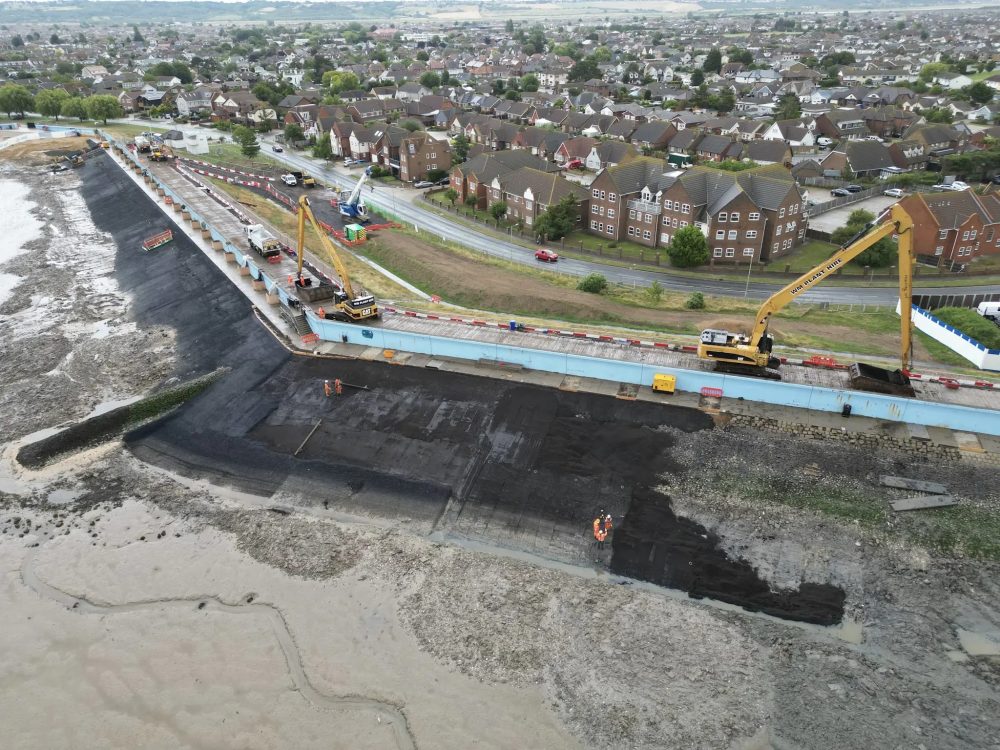
Balfour Beatty has achieved a remarkable milestone on the Thames Estuary Asset Management 2100 (TEAM2100) framework, one of the UK’s most complex and vital flood defence programmes. Working alongside Qflow, a leading digital construction data management specialist, the company has set a new benchmark for sustainable infrastructure delivery and responsible sourcing in the digital construction sector.
As the UK faces growing threats from tidal flooding and climate change, TEAM2100 represents a critical part of the nation’s long-term resilience strategy. The programme, set up by the Environment Agency, aims to ensure that flood defences along the Thames Estuary remain safe, reliable, and sustainable for decades to come.
The challenge: managing environmental data at scale
Delivering on the Environment Agency’s stringent environmental standards was no small feat. Every tonne of waste, material delivery, and sourcing decision needed to be logged, verified, and audited for compliance, a process that traditionally involved extensive manual data entry and paperwork.
In large-scale civil engineering projects, environmental accountability is often hindered by fragmented data and inconsistent reporting. For TEAM2100, maintaining real-time visibility across waste management, material sourcing, and emissions was essential not only to meet regulatory obligations but also to demonstrate leadership in environmental stewardship and digital construction best practice.
Data as a New Form of Infrastructure
Recognising the scale and complexity of the data challenge, Balfour Beatty partnered with Qflow to digitise and automate environmental performance reporting. Qflow’s smart data capture and analysis platform integrates directly with site operations, extracting verified environmental data from delivery notes, waste transfer documents, and supply chain records in real time.
This digital integration replaced the need for manual data collation, enabling sustainability teams to focus on proactive decision-making rather than administrative tasks. The result was a seamless flow of information between site operations and management teams, ensuring that every material and process aligned with the project’s sustainability objectives.
The partnership demonstrated how digital data management can act as a foundation for better environmental performance, effectively making data a new type of infrastructure asset in its own right.

Measurable impact: exceeding sustainability targets
The environmental results achieved through Qflow’s digital platform were as follows:
- 99.6% waste diversion from landfill, exceeding the 96% target
- 99.1% responsible sourcing compliance, far surpassing the industry average of 20–30%
- Automated environmental data capture and verification, improving audit accuracy and efficiency
These outcomes underscore how real-time environmental data can transform project delivery. Instead of relying on retrospective reporting, Balfour Beatty’s teams could engage in live, data-driven discussions with the client, enabling more informed decision-making and demonstrating verifiable progress towards sustainability goals.
Leo Connolly, Sustainability Manager at Balfour Beatty, emphasised the value of automation: “The biggest support that Qflow offered was time-saving. Automation of the system provided workable, confident data for us to discuss with the client without needing to spend days going through documents.”
Aligning with National Climate Resilience Goals
The success of TEAM2100 comes at a pivotal moment. Both the Met Office and the Environment Agency have issued warnings about the increasing severity of tidal flooding across the UK due to climate change. Infrastructure resilience has therefore become a central pillar of national planning and investment strategies, including the government’s Net Zero and National Infrastructure Strategy objectives.
By achieving near-perfect levels of responsible sourcing and waste management, Balfour Beatty has demonstrated how digital transformation in construction can directly support these wider climate adaptation goals. The use of advanced construction data management systems like Qflow ensures that sustainability performance is measurable, verifiable, and scalable, a vital capability for the future of resilient infrastructure delivery.
A blueprint for the future of digital construction
Following the success of the Thames Estuary framework, Balfour Beatty is now extending Qflow’s platform across other major infrastructure projects, including the Wallend Substation. The approach offers a replicable model for combining engineering excellence with digital sustainability management.
As environmental regulations become increasingly stringent, and as clients demand greater transparency, digital data management in construction will play a defining role in shaping the industry’s sustainability outcomes.
The TEAM2100 project is more than a success story, it is a blueprint for how digital innovation can drive environmental performance, strengthen regulatory compliance, and futureproof the built environment against the impacts of climate change.
Read next: A paradigm shift in robotics ownership and strategy – Build in Digital
Are you a building professional? Sign up for a FREE MEMBERSHIP to upload news stories, post job vacancies, and connect with colleagues on our secure social feed.