
Approval of Manchester Digital Campus signals major investment in UK digital construction and government transformation strategy.
The approval of the outline business case for the Manchester Digital Campus (MDC) marks a decisive milestone in the UK’s digital infrastructure and public sector transformation agenda. Backed by HM Treasury, the programme establishes a large-scale government digital hub in Manchester, aligning with the wider government digital and data strategy and reinforcing commitments under the Places for Growth programme.
The development will be delivered through a partnership between the Cabinet Office and the Government Property Agency, ensuring cross-departmental coordination and alignment with national property and digital transformation objectives.
Brownfield regeneration and digital construction delivery
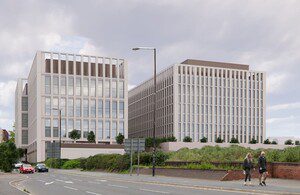
Located on brownfield land in central Manchester, the Manchester Digital Campus represents a significant example of sustainable urban regeneration enabled through digital construction methodologies. The project will deliver approximately 900,000 square feet of purpose-built workspace across two buildings, designed to accommodate around 8,800 civil servants working across multiple departments.
From a digital construction perspective, schemes of this scale increasingly rely on Building Information Modelling (BIM), digital twins, and data-led asset management strategies to optimise lifecycle performance. The MDC is expected to align with these best practices, supporting efficient design coordination, construction delivery, and long-term operational performance.
Construction activity is projected to generate approximately 4,900 direct jobs over a four-year build period, highlighting the role of digital construction in supporting both economic growth and workforce development in the North West.

Supporting the UK government’s digital workforce strategy
A core strategic driver behind the Manchester Digital Campus is the ambition to expand the proportion of civil servants working in digital and technology roles. The government aims to increase this figure to 10% by 2030, compared with just over 5% currently.
By consolidating digital expertise within a single, purpose-built environment, the MDC will act as a catalyst for innovation, collaboration, and service delivery transformation. The campus is expected to strengthen regional digital ecosystems while enabling government departments to scale digital capabilities more effectively.
Cabinet Office Minister Anna Turley emphasised the regional and strategic importance of the project: “We are turning disused land into a digital centre for government, boosting local growth and supporting regeneration of Manchester’s vibrant city centre.
“I am a firm believer that the best ideas often come from those on the frontline. Our plans will move decision-making out of Whitehall and into cities like Manchester, to ensure national policy is informed by local expertise. This will deliver real, tangible benefits for communities across the North, as well as saving the taxpayer billions of pounds.”
Delivering digital transformation at scale
Programme leadership has highlighted that the Manchester Digital Campus goes beyond physical infrastructure, representing a fundamental shift in how government operates.
Philippa Harvey, Senior Responsible Owner for the MDC Programme, stated: “This is the end of the beginning for a programme that has required extraordinary commitment from a huge number of people across government, in Manchester, and across the wider region. MDC is not just a new building – it is a transformation of how government works, bringing together digital expertise at scale in a world-class environment, fully embedded in the community we serve. I am enormously proud of what has been achieved by all involved and excited about what comes next.”
This focus on integration, scalability, and digital capability aligns with broader trends in digital construction, where data-driven environments and collaborative platforms underpin complex project delivery and long-term asset performance.
Regional economic impact and social value investment
The Manchester Digital Campus is also positioned as a major contributor to regional economic development. According to Bev Craig, Leader of Manchester City Council: “This is a significant announcement for our city. The Manchester Digital Campus will be a landmark programme that cements Manchester’s growing global reputation in Digital and Cyber industries, creating major opportunities for residents and a huge boost to our city.
“Transforming a derelict site will see thousands of Government jobs concentrating in Manchester, as well as supporting 4,900 construction jobs and an unprecedented £2.3bn in social value investment that will directly improve the lives of Mancunians and the communities they call home.
“This is also a clear commitment by this Government to invest in Manchester and a statement that northern investment is good for our city and our region, and it’s also good for the economic growth of the UK.”
The programme’s £2.3 billion social value contribution underscores the increasing importance of measuring outcomes beyond capital delivery, a growing priority within digital construction frameworks and public sector procurement.
Manchester Digital Campus represents a strategic investment in digital construction, government capability, and regional growth, establishing a scalable model for future public sector infrastructure and innovation across the UK.
Read next: Work begins on advanced cancer treatment centre – Build in Digital
Are you a building professional? Sign up for a FREE MEMBERSHIP to upload news stories, post job vacancies, and connect with colleagues on our secure social feed.
