
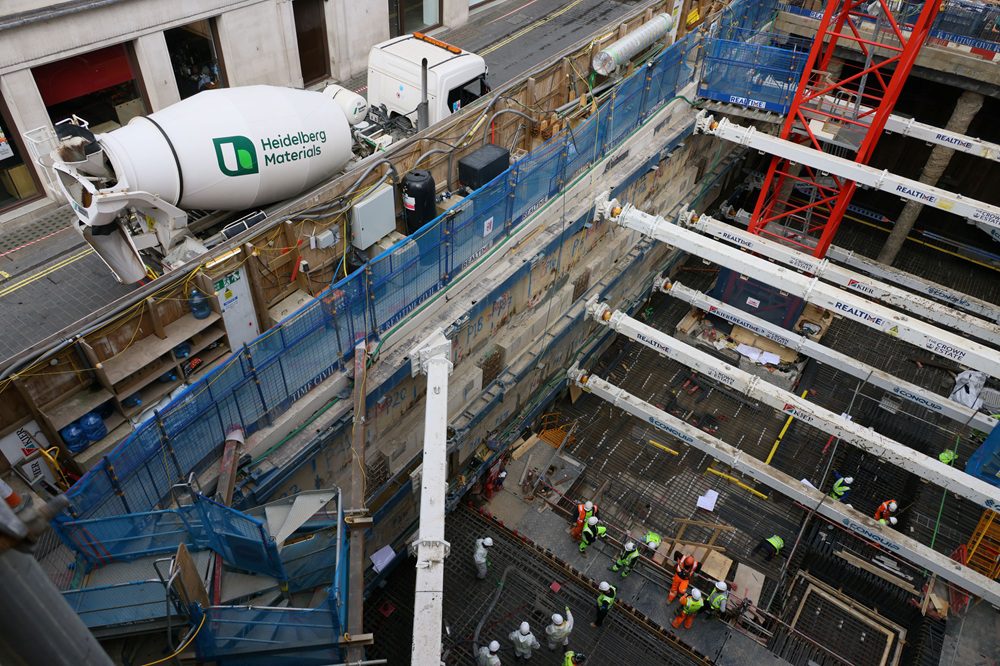
Heidelberg Materials UK is supplying its evoBuild low carbon concrete for basement floors at a scheme in London’s West End – the first UK use of the product.
The Crown Estate-owned office building 33-35 Piccadilly is undergoing redevelopment. Designed by architect DSDHA, it is targeted to achieve a NABERS 5-star rating, WELL Platinum certification and BREEAM Outstanding.
Heidelberg is supplying around 3,000 cubic metres of its low-carbon concrete from its King’s Cross plant. The company said the lower-carbon cementitious content delivers a 35% carbon saving over standard CEM I, alongside improved durability.

The concrete combines evoBuild low carbon cement, part of the firm’s carbon-captured cement range, with evoBuild low carbon GGBS. The mix was developed in partnership with groundworks contractor Realtime Civil Engineering, working for main contractor Kier, to help meet the scheme’s sustainability targets while improving durability.
The evoBuild cement is produced at Heidelberg Materials’ Brevik plant in Norway, where carbon capture and storage is said to cut CO2 emissions from production by around 50%. The concrete also contains evoBuild GGBS, a by-product of steelmaking, which the company said is less permeable than standard CEM I and extends the concrete’s durability.
Heidelberg is separately supplying evoBuild low carbon concrete with a waterproofing system to protect the basement floors from water ingress.
Phillip Rice, concrete key account manager at Heidelberg Materials UK, said: “The project at 33-35 Piccadilly is set to be an exemplar in sustainable redevelopment. Through collaboration with The Crown Estate, Kier and Realtime Civil Engineering we were able to offer an innovative concrete solution that met the rigorous demands of the project while minimising its carbon impact.”
Colm Henry, contracts manager for Realtime Civil Engineering, said: “Realtime Civil Engineering had the pleasure of working with a progressive client team on 33-35 Piccadilly, which allowed us to engage Heidelberg Materials to successfully develop the evoBuild low carbon concrete mix.
“Previously, low carbon saving mixes affected the concrete performance on initial curing times, but the evoBuild mix has overcome this issue. This benefits our overall carbon footprint with no compromise on our construction programme.”
Graham Potts, regional director at Kier Construction London & Thames Valley, said: “33-35 Piccadilly is the latest example in our growing commercial portfolio in London and highlights the value of embedding carbon considerations from the outset and maintaining that focus throughout delivery.
“Through our strong partnership with The Crown Estate and Heidelberg Materials UK, and by combining our in-house design and engineering expertise, we’re proud to introduce this lower-carbon concrete solution to the UK for the first time. This innovative approach enables us to closely monitor and reduce carbon throughout the project lifecycle while helping meet growing demand for lower-carbon, cost-efficient buildings.”
James Atherton, development director at The Crown Estate, said: “Across 33-35 Piccadilly and our wider portfolio, we are taking a holistic approach to reducing carbon, including looking at the materials and construction methods we use to deliver high-quality workplace. This is central to our ongoing long-term work to create a more future-ready West End. We are delighted to be working with Heidelberg Materials UK and the wider project team to bring an innovative lower-carbon concrete solution to the UK for the first time.”
Read next: Natural Power wins EGL5 ground investigation contract
Are you a building professional? Sign up for a FREE MEMBERSHIP to upload news stories, post job vacancies, and connect with colleagues on our secure social feed.
