
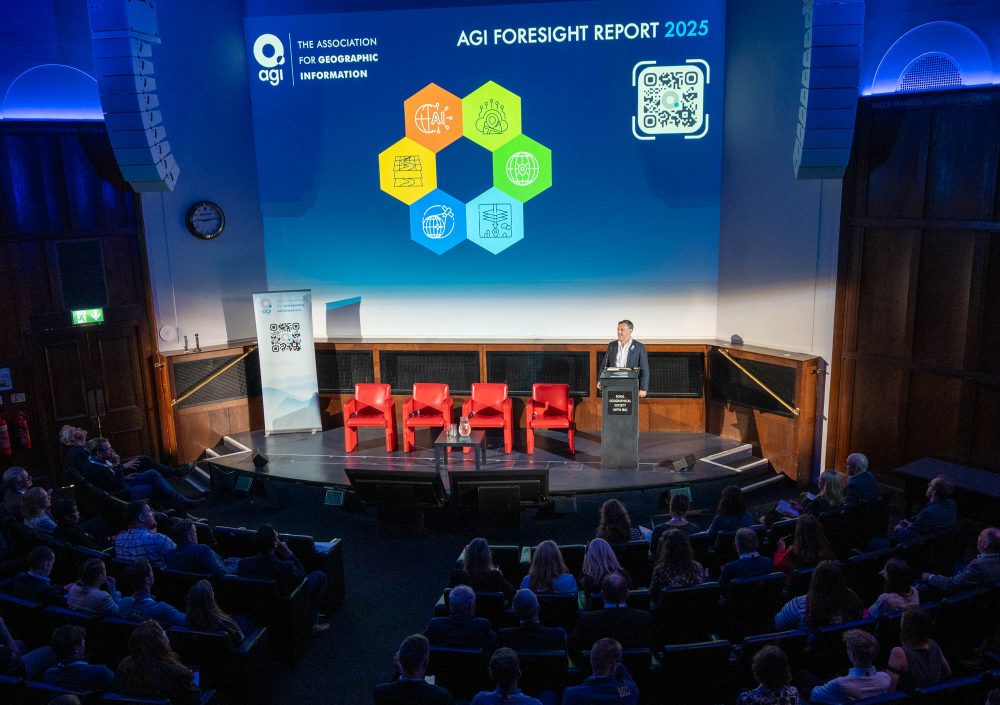
A new report from the Association for Geographic Information (AGI) is calling for immediate action to ensure the UK fully harnesses the power of location intelligence to drive innovation across the digital and built environment sectors. The AGI Foresight Report 2030 outlines six forces set to reshape the future of geospatial intelligence: Data, AI, Interoperability, Skills, Collaboration, and Earth Systems, marking what it describes as the most significant transformation in geospatial data since the rise of digital mapping.
The report warns that without coordinated action and investment, the geospatial sector risks becoming ‘infrastructure that others control, essential but invisible.’ According to Peter ter Haar, Co-Chair of the AGI, this is a crucial moment for the industry to define its future role. “We are at an important inflection point for our industry, and it is every leader’s role to take these changes seriously,” he said. “Without productive adaptation, the geospatial sector risks losing visibility and influence at a time when its capabilities are more critical than ever.”
Location intelligence and the digital economy
The AGI report highlights how geospatial technologies now underpin almost every aspect of modern life, from smart city planning and infrastructure design to environmental monitoring and asset management. As the digital construction sector increasingly relies on accurate, interoperable data to support Building Information Modelling (BIM) and digital twins, the need for trusted and accessible location data has never been greater.
David Henderson, Chief Geospatial Officer at Ordnance Survey, emphasised the sector’s evolving role. “Geospatial has become a set of multifunctional capabilities that support decision-making across all sectors. The AGI Foresight Report 2030 provides an opportunity to reflect on how location data will shape the UK’s digital economy,” he said. “We must embrace AI, ensure data is trusted and traceable, and accelerate investment in future skills.”
Sector collaboration and the future of geospatial data
The AGI launched the Foresight Report 2030 at its annual AGI Foresight 2025 Conference, held at the Royal Geographical Society (with IBG) in London. The event brought together more than 200 professionals from government, academia, and industry, including keynote speakers Ed Parsons, Geospatial Technologist at Google, and Denise McKenzie, Managing Partner at the PLACE Trust. The agenda featured insights from AtkinsRéalis, Idox Geospatial, and 1Spatial, alongside an interactive session led by the AGI Early Career Network.
The report identifies six interconnected themes driving change across the sector:
- The Data Imperative – improving data quality, access, and governance
- The AI Integration Challenge – exploring automation and intelligent analytics
- Infrastructure Evolution – creating interoperable, resilient data systems
- The Collaboration Imperative – strengthening partnerships across disciplines
- Earth Systems Revolution – integrating environmental data to support sustainability
- The Skills Revolution – building the workforce required to lead in geospatial innovation
A call to action for the geospatial and digital construction community
Fergus Craig, Co-Chair of the AGI, concluded the conference by calling for collective responsibility to advance the geospatial agenda. “It has been inspiring to see the sector come together to address these challenges,” he said. “Now we must move forward boldly, advocate for the value of location intelligence, and ensure its benefits are fully realised.”
The AGI Foresight Report 2030 is available to download from the Association for Geographic Information’s website: www.agi.org.uk/foresight-report.
Read next: AI master’s scholarships to boost UK tech innovation – Build in Digital
Are you a building professional? Sign up for a FREE MEMBERSHIP to upload news stories, post job vacancies, and connect with colleagues on our secure social feed.

